

View
by Phil Bartkowski and Tim Jed 39 minute read
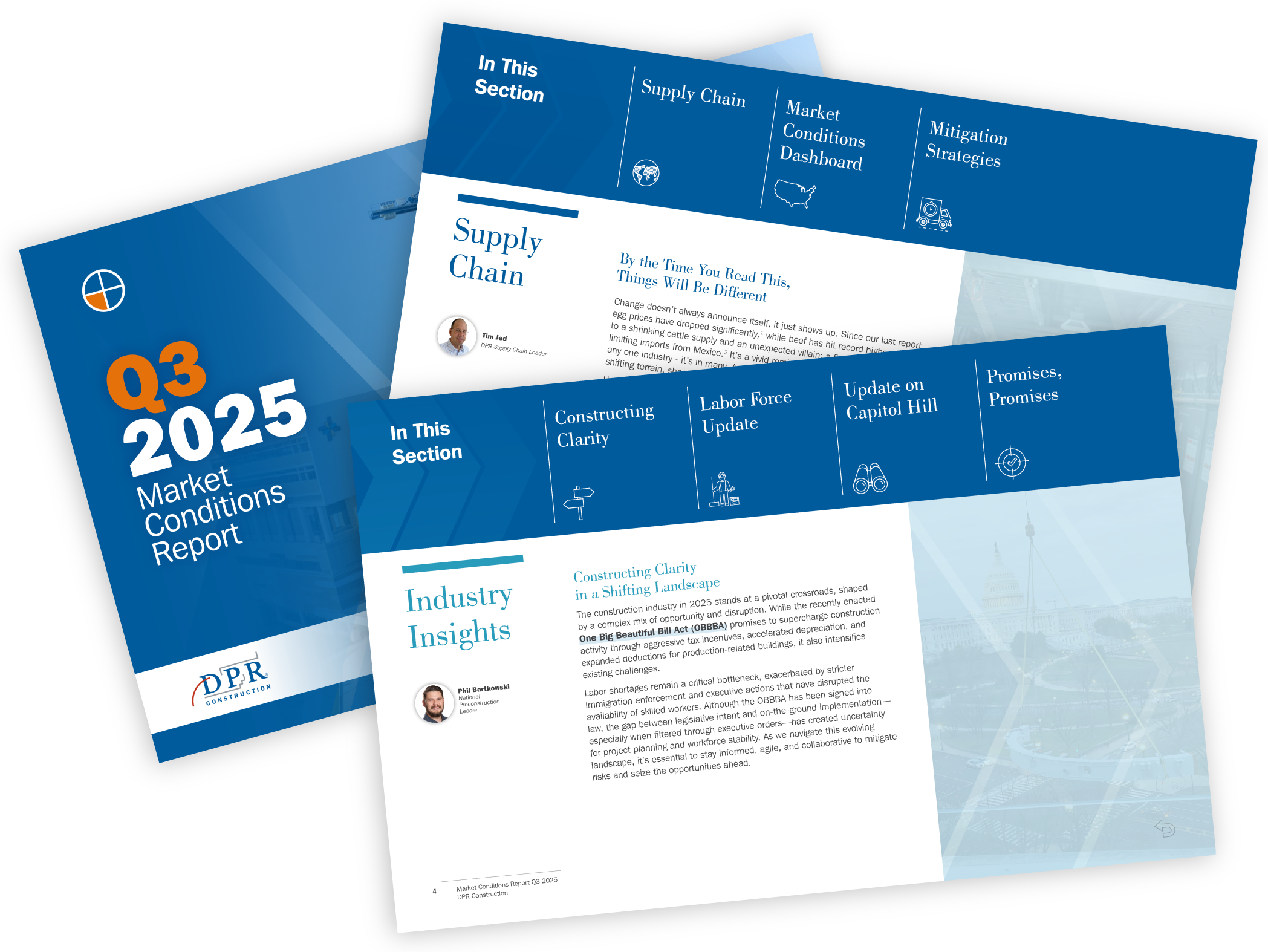
Our Q3 2025 Market Conditions report summarizes current market conditions, industry trends, and mitigation strategies to make more informed business decisions in the quickly changing construction landscape.
The construction industry in 2025 stands at a pivotal crossroads, shaped by a complex mix of opportunity and disruption. While the recently enacted One Big Beautiful Bill Act (OBBBA) promises to supercharge construction activity through aggressive tax incentives, accelerated depreciation, and expanded deductions for production-related buildings, it also intensifies existing challenges.
Labor shortages remain a critical bottleneck, exacerbated by stricter immigration enforcement and executive actions that have disrupted the availability of skilled workers. Although the OBBBA has been signed into law, the gap between legislative intent and on-the-ground implementation—especially when filtered through executive orders—has created uncertainty for project planning and workforce stability. As we navigate this evolving landscape, it’s essential to stay informed, agile, and collaborative to mitigate risks and seize the opportunities ahead.
Labor is a tough thing to talk about without personalizing it. Each hour on a project is a human being. Every job opening unfilled is being applied to by real humans. Buildings won’t get built without us. This quarter we take a tour of several major headlines surrounding the labor market and help validate or refute some of the concepts from DPR’s unique perspective in the industry.
| Industry Narrative: | The DPR Perspective: | |
| Associated Builders and Contractors (ABC) reports that, year-to-date, the construction hiring rate is lower than in any year since that information has been tracked in 2000, with job openings down about 35% year over year. Associated General Contractors of America (AGC) research shows that although construction job gains have slowed, they still are better than other industries, and construction employment is actually growing in 31 of the 50 states. Macrina Wilkins, senior research analyst for the AGC, said “Even with fewer openings and hires, firms are holding on to their current workforce, emphasizing the value placed on skilled workers, particularly with persistent labor shortages, and even with the uncertainty around project pipelines.”i | While national data reflects a slowdown potential, DPR currently has over 300 open positions—from superintendents to data engineers, from journeyman electricians to estimators. We’re growing teams across the country right now when other firms may be treading water. |
| Industry Narrative: | The DPR Perspective: | |
Hiring is soft, but layoffs remain historically low, this suggests firms are clinging to existing talent due to economic uncertainty. | We are always focused on retaining our best builders, and we aren’t just keeping them in a holding pattern, we are operationalizing them and investing in upskilling. We’ve developed new pathways for DPR team members to travel and get experience they might not have available at their local offices and ultimately bringing back invaluable perspectives and expertise. We have also invested heavily on the path for our recent graduate Project Engineers, ensuring that they have the opportunity to gain a variety of experience and be certain about ‘what’s next’ in their careers. This is all in support of our efforts to be a Best Builder, and it’s the right time to invest in our people in new and exciting ways. |
| Industry Narrative: | The DPR Perspective: | |
The ABC estimates the industry needs 439,000 new workers in 2025. Aging skilled labor and a thin talent pipeline are widening the gap. | Our workforce is not entirely imbalanced; in fact, in some regions 60-70% of our DPR population is between the ages of 20-49 and 50% between 20-40. We have a lot of knowledge and experience to harvest from our great builders in the upper brackets of the age bands. Our strategy is to surround them with great support and let our younger workforce learn from those that have forged their path at DPR. In fact, more Gen Z workers are opting to skip traditional four-year degrees in favor of skilled trades—a shift driven by debt fatigue and job security. |
Is there a challenge that exists? Yes and when we’ve talked about the topic in our past report’s, our solution has and continues to be proactivity. Will others in the industry sit around and wait for folks to ‘age-out’ and then figure it out? Most builders we build side-by-side with are actively attempting to compete for the same limited workforce. We know that we must bring youth into our companies strategically, offering a career path and development for the long-term.
| Industry Narrative: | The DPR Perspective: | |
Worksite raids have slowed project timelines, disrupted jobsite labor and highlighted dependence on undocumented labor in industries like construction. |
The Immigration and Customs Enforcement (ICE) groups have been charged with detaining those who are in the U.S. illegally. There have been highly publicized stories about mischaracterized individuals, or complete project shutdowns. While we haven’t seen this as a widespread challenge on our sites specifically, there is data from AGC research aggregating percentages of “foreign-born” trade workers, with over 50% in trades like plaster/stucco, drywall installers, roofers, painters. |
The U.S. has been a country of immigrants for a long-time; these numbers reflect that. If the U.S. government decides to further restrict the legal immigration process then yes, we could definitely assume a potential significant impact on some of these trade roles over time.
In our Q1 2025 report, we broke down several Executive Orders that the President released and said that we wanted to ‘keep an eye on them’ to see what happens. Well, we didn’t have to wait too long, at least on some of them.
If you haven’t heard, the One Big Beautiful Bill Act (OBBBA), signed into law on July 4, 2025, is a massive tax and spending package aimed at boosting the U.S. economy through deep tax cuts, expanded infrastructure and defense spending, and new incentives for American energy and manufacturing. It reshapes everything from income taxes and student loans to border security and federal construction—marking one of the most sweeping economic overhauls in decades.
The OBBBA could be generally seen as contractor-positive, especially as it relates to federal work, industrial building or heavy infrastructure work. The combination of aggressive tax policy, expansion of federal spending and strategic workforce investments creates a growth environment. However, certain sectors or focus areas may not experience the same benefits and could face new headwinds (i.e. clean energy, housing or public institutional work, etc.). Likewise, broader macroeconomic risks, such as increased deficits and delayed permitting reforms, also temper some of the bill’s upside.
Let’s look at a few specific topics:
Major funding is being allocated in aviation, border infrastructure, military bases, and shipyards. This should provide a solid backlog in those sectors of work, but these are typically insulated or isolated from the local markets. So this is great if that’s your focus, but will it have a broad ‘local’ impact on building? Probably not.
There are new policies that are potentially exceptionally favorable to construction companies, real estate developers and private entities. There is now a permanent 100% bonus depreciation for commercial and industrial buildings. This will dramatically improve cashflow for projects by allowing businesses to deduct the full cost of qualifying assets in the year they are placed in service (buildings, machinery, equipment, etc.). This applies to “qualified production property” only, but historically, commercial buildings depreciate over decades, not days.
Developers and investors may initiate large-scale projects quicker knowing that they can recover costs faster, and it may even make financing easier seeing a stable cash position and stronger cash flow.
Section 179 Expensing increases the cap to $2.5M, allowing businesses to immediately deduct the full cost of some equipment and property improvements in the year they are placed in service. This accelerates deductions for construction firms and other businesses purchasing heavy equipment, tools, or even making tenant improvements.
There is also a temporary roll back of IRS Code allowing companies to add back depreciation and amortization when calculating their adjusted taxable income. This, combined with what is mentioned above, ensures that businesses can fully deduct interest on loans used to finance large projects.
The OBBBA also includes an expansion of Pell Grants for short-term trades training. This could be a major win for the construction industry. Eligibility has now been extended to job training programs lasting from 8 to 15 weeks starting in July of 2026. These historically have been reserved for longer academic tracks that take years to complete.
This expansion should help remove financial barriers to accessing the programs and services people need to enter the trades—where we have a high demand for skilled workers. Also, going through formal ‘schooling’ before showing up on a jobsite could dramatically enhance the quality and safety of the work being performed and may put these individuals on an accelerated path onsite.
There are sweeping departures from the clean energy incentives established under the Inflation Reduction Act. Most of the credits for solar, wind and other renewables are being phased out rapidly. Existing clean energy projects in play now have tighter deadlines to qualify for any remaining incentives. There is an elimination of electric vehicle and residential energy incentives and will reduce any support of consumer alternative energy adoption. In addition, an exclusion of credits for any projects involving certain foreign-controlled or led entities, with a hyper-focus on China specifically. Some pretty dramatic policy shifts here.
The emphasis is on fossil fuel infrastructure enablement and U.S. sourced materials. The OBBBA implicitly takes the U.S. toward a deeper investment on oil, gas, and coal-based infrastructure.
There is a risk of this bill leading to higher interest rates according to some financial experts, and raising the cost of capital for private development efforts could reduce the speculative project building volume overall. The bill is projected to increase the deficit by $2-$4 trillion.
When President Trump came into office, he immediately began executing Executive Orders. There was an unprecidented flurry to keep up with. From Inauguration Day to July 4, 2025, about 170 executive orders were published!
In our Q1 2025 report, we highlighted 14 executive orders that we wanted to keep our eye on. It didn’t take long for an idea to go from an executive order to a bill to a law in some but not all cases. The OBBBA didn’t tackle everything. While there are still some topics not addressed, about 50% of the orders we thought could affect us are now included in some way in the new law.
Let’s take a look at the comparison:

Of the 14 executive orders we highlighted in Q1 2025 with potential construction industry impacts, about 50% have been addressed through the OBBBA.
You can really sense the pace picking up with these new policies—whether you’re for them or against them, things are moving fast. The noise around tariffs, imports, and different agency rules is set to shake up industries like construction and building. Instead of everything going through the usual legislative process, we’re seeing a mix of executive orders and agency actions driving these changes. That means businesses need to keep an eye not just on new laws but on all the behind-the-scenes moves, since these could affect how things run over the next few months.
In short, the latest policies demonstrate that the government is taking a lot of different routes to tackle trade and border issues. Even when something isn’t written directly into the bills—like new duties at the borders—they’re finding other ways to make it happen. As these changes continue, they’ll likely ripple through multiple industries, so it’s smart to stay alert and ready to adapt.
For DPR, this dynamic environment underscores the importance of agility and foresight. Whether it’s adapting procurement strategies in response to new import duties or ensuring compliance with evolving agency rules, DPR continues to bring a proactive, solutions-oriented approach to every challenge.
Change doesn’t always announce itself, it just shows up. Since the beginning of the year, egg prices have dropped significantly,1 while beef has hit record highs, thanks to a shrinking cattle supply and an unexpected villain: a flesh-eating parasite limiting imports from Mexico.2 It’s a vivid reminder that volatility isn’t limited to any one industry—it’s in many. And in construction, we’re navigating our own shifting terrain, shaped by tariffs, economic crosswinds, and global uncertainty.
Unpredictable changes in tariff, budget, and immigration policies are creating a lot of ambiguity. Bloomberg reports that tariffs, tax credits, and loan approval issues have affected construction projects, particularly in clean tech, and notes that “nearly half of the $30 billion in clean tech factories scheduled to come online in 2025 are now predicted to face delays or cancellations.”3 By contrast, in other core markets, contractors see robust demand, like the strong early-stage activity in 2025 for data centers (which make up 70% of increases in private nonresidential construction spending March ’24 to March ’25 year over year). Amazon, for one, plans to invest $20 billion in new facilities.4
So, the change is constant, and while there’s a lot of economic indicators out there, many are giving us contradictory messages. This makes it difficult to proactively plan a strategy. Here are a few markers that seem to tell conflicting stories:

The U.S. GDP is down, along with U.S. currency against other major world currencies year-to-date, but the stock market is repeatedly setting new all-time highs.5 Inflation is down from January, but this hasn’t triggered an easing of interest rates, due to the belief that the inflation rate does not yet fully reflect the effects of the tariffs, with many worried that an increase in inflation may also increase unemployment.
So how do we adapt and what does the path forward look like? This quarter, we’ll look at the fast-changing landscape facing construction and supply chains, rising tariffs, unpredictable economics, and geopolitical concerns. We’ll dive into what companies are doing to adapt and build resiliency. And we’ll share what we’re seeing with technology and AI and discuss how DPR is navigating this volatility.
Tariffs are having a significant impact on trade. In April 2025, the U.S. trade deficit dropped sharply (to $61.6 billion) driven primarily by falling imports to the U.S. (down 16.3%).6 This is the lowest it’s been since 2023, when we were coming out of COVID. Juxtapose this to GEP’s Supply Chain Volatility Index survey, which fell in June, signaling a higher degree of spare capacity across global supply chains7. In normal times, this excess capacity would drive prices lower, but material prices continue to rise, and the excess capacity could actually disrupt supply chains by creating inefficiencies, reducing economies of scale, and eroding readiness for future demand fluctuations. Senior procurement professionals are concerned, and the 2nd Quarter 2025 CIPS Pulse Survey echoes this concern, posting record high risk scores for potential disruptions, both the short and long-term.8
This apprehension is not limited to procurement professionals.
The number of Google searches for “tariff” spiked as people try to understand how this will impact them. Since our last report, we’ve seen increased tariffs on semiconductors (+25%), steel & aluminum (+25%), copper (+50%),9 and some expanded tariffs on certain countries and products. The “reciprocal tariffs” were put in place on April 9th but then paused for 90 days to allow time for trade negotiations with affected countries. During this pause, all countries were subject to a baseline 10% tariff. The deadline was extended again to August 1st in order to allow more time for negotiations. As the date approached, the White House sent letters to 21 countries outlining their tariffs percentages if other agreements could not be reached by the deadline.

The number of Google searches for “tariff” spiked in 2025 as people try to understand how this will impact them.
As of August 5th, trade frameworks have been established with seven countries – China,10 Indonesia,11 Japan,12 Philippines,13 South Korea,14 UK,15 and Vietnam16—plus the 27 countries of the EU.17 On July 31st the new list of tariffs18 was released for nearly 100 countries, with the remaining countries at the baseline 10% tariff set in April. These new tariff rates took effect on August 7th. To avoid situations of transshipment – the practice of routing goods through an intermediary country to misrepresent their true country of origin and evade import duties—the Administration included a clause19 to impose a 40% tariff in lieu of any other tariff for violating these terms.
Threats of secondary tariffs, which represent a recent development in economic diplomacy, and which aim to influence the behavior of third-party countries, have been established for purchasers of Venezuelan oil and Russian oil. As of August 6th, India20 is the only country which has been levied with these tariffs for their continued purchase of Russian oil. Beginning August 27th, an additional rate of 25% will be applied to all imports from India.
Finally, effective August 29th, the tariff exemption provided for goods valued at $800 or less is no longer in place for imported goods, with fixed rates assessed if mailed through the international postal system.21
Prior to January 20th, tariffs applied by country en masse were a rarity, as tariff policy tended to be applied in a more surgical approach (by product). Although there have been several legal challenges to the tariffs, the tariffs remain in effect until those appeals are settled.22 As of 8/5/2025, here’s where we stand:23

Reciprocal tariff rates by country as of August 5, 2025.

1a Exclusions for Canada, Mexico, Australia; allowed quotas for Argentina, Brazil, South Korea, the EU, Japan, and the United Kingdom
1b Existing exclusions and quotas removed; new exceptions and quotas may be built into trade frameworks
2 US Imposes 35% Duties on Russian & Belarusian Goods | PCB News
3 Exceptions for items covered by the US Mexico Canada Agreement (USMCA) which have no tariffs – except for steel and aluminum
4 24% of U.S. petroleum processing comes from Canada
5 United States Finalizes Section 301 Tariff Increases on Imports from China | White & Case LLP
6 Trump says 50% tariff on copper imports will begin Aug. 1 | CNBC
7 U.S. Tariff Policy in Flux: July Executive Actions Add Clarity and Complexity | gibsondunn.com
So, what is the cost impact, and who pays?
The U.S. Chamber of Commerce has calculated that at the start of 2025, the average for U.S. tariffs were around 2% ~ 3%. As of June, average tariffs are estimated to be 15% ~ 18%.24 Tariffs are collected by U.S. Customs and Border Protection, which are then deposited into the General Fund of the Treasury Department to fund various federal government operations and programs. Since the additional costs to products are ultimately reflected in the price of the goods sold in the U.S., they are borne by consumers who purchase those products—they are essentially a tax, representing the highest tax increase in peacetime in 57 years.25
There are also other potential compounding effects to watch for. Over the last several months, there has been a lot of back and forth between China and the U.S., increasing tariffs in response to each other. The U.S. is pushing for “China content restrictions,” which could add additional tariffs to products from other countries that use Chinese materials. For instance, if products from Mexico contain Chinese materials, those products could have tariffs applied at China rates, even if those products were tariff-free under the existing USMCA (United States-Mexico-Canada Agreement).26
The supplier community is responding. From January 20th through August 5th, we’ve received 7,800 impacts relating to price and lead times. Material costs are a percent of a percent of the subcontracted costs, so the actual dollar impact to a project budget will be a much smaller percentage impact than when looking at the material only.
Bearing that in mind, here’s a breakdown of the price increase requests we’ve received from our suppliers and the relative order of magnitude of impact by trade, in comparison to others:

Aggregating data from over 7,800 supplier impacts related to price and lead times between January 20th and August 5th.
One product that affects material costs across many trade categories is steel. Schuff Steel reports that we will see increased lead times (moving the maximum lead time from 6 to 14 weeks), and notes that mills are running only at roughly 80% of capacity, with order volumes increasing. While there is strong demand, it has not led to any mill increases since April, since much of the increased demand is being absorbed by service centers that stocked up earlier on their supply.27 For other product categories, we’ve received feedback that other construction segments (e.g. homebuilding) have softened, which has lessened demand for some materials, but manufacturers are seeing energy prices increasing, as well as increased pricing for materials used in the manufacturing of their products. No doubt the recent fires in Southern California and floods in Texas will exacerbate construction material prices related to homebuilding, at least regionally, for materials like lumber, siding, drywall, and roofing.
U.S. retailers are accelerating efforts to change their product sources to countries with lower tariffs. Target aims to lower its dependence on China-sourced goods down to 25% by 2026, Gap plans to cut China’s share to under 3% by the end of 2025, and Macy’s has reduced its Chinese inventory share to 18%,28 shifting their manufacturing to other countries to reduce the cost impact to their products.
Despite its challenges with water shortages and outdated infrastructure, many firms, like BMW and Volkswagen, are shifting their manufacturing to Mexico to avoid trade penalties, as about 90% of the products being shipped to the U.S. from Mexico are tariff-free29 (thanks to the USMCA). While changing can provide pricing relief, experts warn that shifting sourcing locations internationally may also carry political risks, which should be considered in the long-term supply chain strategy.30 And while cost is important, higher prices from tariffs aren’t the only challenge we’re facing. The resulting trade war between China and the U.S. has spawned export restrictions by China for critically needed materials.
In response to the trade war, China began limiting exports in April for seven Rare Earth Elements (“rare earths”). This has been enacted through creating new licensing rules for exporters to ship these materials abroad. While not a total ban, China can effectively slow down or block shipments by stalling licenses.31 This is a big deal, as China accounts for about 90% to 95% of rare earth material processing worldwide.32 Companies in Europe and India are already reporting issues getting export licenses, and U.S. firms are scrambling to find alternative suppliers, as ramping up domestic production is likely years away.33 This has affected key materials used in everything from fighter jets and submarines to electric motors and electronics.34 One auto plant in Chicago was reportedly shuttered for a week due to delays created by this situation.35
Around 78% of U.S. defense systems rely on Chinese-processed rare earths. Companies like Lockheed Martin and Raytheon could face higher costs, shortages of materials to manufacture parts, and production delays. The EV and clean energy sectors are also affected (e.g. automakers like Tesla who need these materials for heat-resistant magnets). Here are some of the main uses in construction:

From tariffs to global trade to rare materials and geopolitics, there’s a lot of nuance.
For a deeper understanding of the real-world impact, check out the July 8th podcast from AGC where we discuss supplier price increases, shifting policies, strategies, and collaborative solutions, and how to stay ahead in an unpredictable market.
ConstructorCast is AGC of America’s monthly podcast.
While the U.S. has started investing in rare earth processing at home, we’re still a long way from matching China’s output, but there’s good news on this front. Some Chinese restrictions have been paused for certain U.S. companies, and in late June, it was announced that a deal between the U.S. and China has been reached that would ease constraints on these materials from China, pending approval by both nations. The U.S. is also working to secure these materials from other countries (like Ukraine and Greenland), and in July, the United States, along with Australia, India, and Japan (known collectively as The Quad) launched the Quad Critical Minerals Initiative, to work together to secure and diversify supply chains for critical minerals (although it is not clear whether these products would be subject to the country-wide tariffs for these materials).
On July 10th, it was reported that the Pentagon is investing $400 million in MP Materials (the only operational rare earth mine in the U.S.), making it the company’s largest shareholder, and Apple announced a $500 million signed deal with MP to secure its rare earth magnets. The funds will expand processing and magnet production at MP’s rare earth mine in Mountain Pass, California.36 In addition, Clarios, a low-voltage battery maker, announced plans to invest up to $1 billion in a new domestic minerals processing facility.37 In the long run, reducing reliance on China for these materials by creating sources domestically and diversifying international sources for these materials will add resilience to these material supply chains, which is positive for the U.S.38
In ocean freight, driven by early ordering to avoid tariffs, shipping volumes were strong through the first quarter, but in May imports fell by 9.7% on news of the 145% China tariffs, which have now settled to a lower level. Many companies are predicting an increase in container rates, but the rapidly shifting tariff policy is affecting import levels, early orders, and shifting sources for product which, in turn, causes volatility in container rates and port volumes, making it difficult to arrive at a sensible forecast on where pricing is headed. We would expect this uncertainty to continue until we have a more stable and predictable policy on tariffs.39 The good news? Right now, we are not hearing about disruptions to shipping, port congestion, or issues with one-way shipping container inefficiencies.
Rail is expected to settle over the next couple of quarters, mostly because volume levels aren’t looking very strong, so, in the near term, rail pricing should remain competitive. However, as we get closer to the end of 2025 and head into 2026, rail pricing may increase and be less competitive when compared to trucking, mainly due to gains in rail volumes, versus truck loadings, which are expected to stay flat.40
In trucking, tender rejection rates (a metric that signals higher pricing) remained elevated for the 17th consecutive month. This occurred despite weaker annual freight volumes and suggests that the truckload market remains tighter than it was during the same period last year. The extended reduction in carrier capacity over the past two and a half years has heightened the industry’s exposure to external shocks (recall from prior DPR Market Condition Reports that many trucking companies have gone out of business). This makes seasonal fluctuations more noticeable. The current outlook indicates a decline in expected truck utilization beginning in early 2026 with a potential tightening in 2027.41
Trucking costs are made up of the vehicle costs, taxes, registration and other fees, insurance, company overhead expenses, truck driver labor, and fuel. There are mixed views on whether a continued conflict between Israel and Iran could drive fuel prices up (Isreal has “no intention of easing off the gas pedal”42). Iran sits at the north side of the Straits of Hormuz. If Iran withholds oil or blockades the Straits of Hormuz, it could create a supply constraint and drive oil pricing up, as it’s the 7th largest oil producer in the world,43 and 20% of the world’s supply traverses the shipping route.44 Oil prices are lower than they were when the conflict re-ignited on June 10th,45 and as of August 5th, oil is down 3% last year-over-year.46 But JPMorgan projects that a prolonged blockade could drive oil to more than $100 per barrel, and as much as $130 in a worst-case scenario (adding $1 per gallon in the U.S.).47 Others believe that prices are not likely to get worse since the U.S., as the largest oil producer in the world, has reduced its reliance on non-U.S. sources, and there is a belief that countries in the Persian Gulf are less inclined to restrict oil exports over political disputes with the U.S.48
There are also potential changes to fuel taxes and registration costs. The Highway Trust Fund (HTF) is the main source to pay for federal transportation and infrastructure projects. It is funded through a federal tax on fuel (18.4 cents per gallon for gas, and 24.4 cents per gallon for diesel). This rate has been in effect since 1993, but since then, there’s been wide adoption of electric vehicles (currently ~8% of new U.S. car sales49), and gas vehicles have become 38% more fuel-efficient. These factors have created a shortfall in the HTF’s budget (FY2026 budget projected to collect only $42 billion of the $79 billion needed50). The intended proposal is to fully fund the HTF by removing the federal fuel tax and replacing it with a yearly flat fee by weight as part of the registration cost (cars $135; 10-14K lbs. $535; 14-16K lbs. $580; and so on). This would result in an increase for all vehicles.51
| Impact | Status | Analysis | Recommendation |
| Land: |
| There have only been slight increases in the flatbed market which means we have not exited the truck recession yet. | Continue to bid level the spot market when volume does not make it cost competitive for contract rates. |
| Rail: |
| The Rail industry continues to make steady gains. However, tariffs in the commercial market will cause less containers and intermodal port use. | Use rail for heavy items which require cheaper per mile costs, flexibility in delivery and short distance from intermodal facilities. |
| Ocean Freight/ Containers: |
| Disruption in global energy markets will have effects on most industries. However, this will be more than likely a short term effect due to the number of countries involved. | Continue to look at the spot markets. |
| This would impact costs for products imported by China. The math is: (% of Container Used for Item) * ($120) = $ Impact | Cost model bringing items in early and storing, compared to additional cost, and select best option. |

Check out our current conditions interactive dashboard.
Spoiler: It’s Complicated
Companies are prioritizing geopolitical and cyber risks in their supply chain strategies, shifting from reactive crisis responses to proactive, data-driven management. A Global Supply Chain Risk Survey of 1,000 senior executives showed that companies are concerned about the potential for inflation, and they are adding dedicated teams and considering AI to help manage their supply chains.
Only 8% of businesses feel fully in control of their supply chain risks, with 63% reporting higher-than-expected losses, as geopolitical instability, inflation, cybersecurity threats, raw material shortages, and regulatory changes emerge as the most rapidly growing concerns.54 In response to global trade disruptions, tariffs, and supply chain volatility, many large companies55 have each advanced nearshoring or regional manufacturing strategies, leveraging local production, trade agreements, and data-driven procurement to enhance resilience and reduce dependency on distant suppliers.56 But this also creates some risks of its own.
A recent Organization for Economic Co-operation and Development (OECD) study that reviewed supply chain resiliency found that the supplier base has narrowed significantly in the last three decades, noting: “China’s contribution to countries’ level of significant import concentration has increased from 5% to 30% over the past 25 years.” It went on to say that policies that favor domestic-only supply chain hurt global GDP, and do not guarantee supply chain resilience.57

A Global Supply Chain Risk Survey of 1,000 senior executives showed that companies are concerned about the potential for inflation, and they are adding dedicated teams to help manage their supply chains.
To avoid forecasting and procurement errors and to increase flexibility, companies are adopting a range of tactics like scenario stress testing, building better data transparency, impact modeling, avoiding sole sourcing while deepening supplier relationships and leveraging supplier intelligence, and using behavioral analytics to catch human biases in forecasts. Taken together, these strategies reduce procurement risk and drive smarter, more sustainable decisions through the entire process.58
About 83% of leaders are already using traditional AI for tasks like forecasting and automation, but there’s a noticeable gap forming in how companies are embracing generative AI in their supply chains, with just 36% starting to explore it. Companies focused on fulfillment, transportation, and order execution show higher adoption at 46%, while logistics firms lag behind at only 16%, mainly because of tighter budgets and resource constraints. The biggest hurdle—mindset shift.59
Trust in this new technology just isn’t there yet, even though early adopters of AI in supply chain management reported a 15% reduction in logistics costs, a 35% decrease in inventory levels, and a 65% improvement in service levels.60 Progress is slow as companies wrestle with issues around data privacy, governance, cost, and technical skill availability. Companies fear that bad AI data could lead to costly mistakes.61
With tariffs in flux and geopolitical tensions reshaping global trade, supply chains are facing a new level of complexity; rising costs, unpredictable logistics, and shifting demand. In this environment, success depends on moving beyond outdated, siloed reporting and instead, treating data as a strategic tool. It means accepting volatility as the norm and building systems that can model costs, anticipate disruption, and respond quickly. Real-time visibility across suppliers, logistics, and customers is essential. Collaboration is no longer optional—organizations must share trusted data across teams and partners to make faster, smarter decisions. AI plays a critical role too, in flagging bottlenecks, identifying alternate sourcing strategies, and helping to automate forecasting.
We are all aware of the challenges of forecasting material needs in commercial construction. Each job is unique, bespoke, and designed for a specific purpose and for a specific site. But forecasting can lead us to aggregation of materials, which provides the ability to plan and direct spend to more strategic suppliers, and to deepen supplier relationships, thereby creating reliability and predictability for our projects.
Last year, DPR began to address the challenge of forecasting and material aggregation through the development of detailed schedule-driven forecasts (aka a “demand plan”). We leveraged our Family of Companies, our internal takeoffs and schedules, and other electronic information to automate and gain insight into how much coil we would need to order in a specific time period to make our own studs for several projects. Since we already manufacture steel studs in-house, namely, for our bathroom pods and prefabricated wall panels, we have the manufacturing equipment and experience to do this.
Once we obtained this information, we used it to procure coil on the international market at a time that was cost advantaged. This strategy creates pricing stability and uses resources we already possess as a self-performing technical builder. This year we are advancing that program for scale and starting to investigate AI to help us leverage information and create similar processes for other products, leading to more volume with strategic suppliers, and deepening those relationships, which will help ensure our project schedules.
But forecasting and aggregating is just one of our strategies. At DPR, we’re meeting supply chain challenges head-on with targeted, forward-thinking approaches that are woven into the tapestry of our unique industry.

Two of our core values—Integrity and Ever Forward—ensure we prioritize effective and collaborative partnerships with our suppliers as we develop and advance innovative approaches to advance our industry. By combining data, collaboration, and strategic foresight, DPR is not just reacting to change, we’re leading through it.
Account Manager
Applying Tariff Data to Real-World Projects
We exist to build great things—great teams, great projects, great people, great relationships, a great place to work. DPR builds in the real world, so real-world issues affect what we exist to build. Unpredictable and unexpected realities from Covid to tariffs to political unrest to geopolitical forces are impacting the work we lead. To confidently facilitate clear, manageable, productive conversations about complicated and dynamic situations, where does one start?
One “relative” genius, Albert Einstein suggested, “everything should be made as simple as possible, but not simpler.” Our way of applying this? Understand, model, post, communicate, and coach our front-line teams through in-house resources to:
To this end, Scott Strom, a DPR Account Manager in San Diego, tackled an estimate by first asking:
“How do we break this out to understand what is subject to tariffs? In these line items, how much is labor and how much is material, because tariffs do not hit labor, they hit the material that is on the job site.”
In the project that Scott first examined, about 40% of the total cost of the project was material, which automatically feels like a more manageable discussion.
Scott’s thought process (“as simple as possible, but not simpler”) is posted on an internal site to help model, communicate, and coach an approach, so any project can apply this process to an estimate, concentrate the relative attention, and mindfully evaluate the tariff challenge. Scott coaches that:
“There’s no material in final cleaning. You’re sweeping; you’re putting in a dumpster…hardly any material in earthwork—you are pushing dirt around, and if you’re buying dirt or rock, generally you are getting it from a local source. So, we said earthwork and demo, probably no impact by tariff.”
This type of thinking led to ranking the items from no risk of 1 to high risk of 6, which are applied to trades according to their material’s exposure to tariffs. When sorted by risk, the higher tariff risk categories begin telling the story. “For materials from countries with higher tariff impacts, you can run those out and get a better idea of the impact of tariffs on the higher risk items and percentage of the overall job. Items like electrical gear, smart breakers—almost all of that is coming from overseas.” The bottom line? Using the Tariff Worksheet, Scott’s project had materials accounting for about 13% of the total job cost that drew his attention to “manage a little bit tighter.”
For high risk items, consider where the materials are coming from. Does this material normally come from China? Scott leveraged AI. Here’s an example:
Query: “What percentage of PVC pipe sold in the U.S. is imported?”
Answer: 66% Columbia, Dominican Republic, and China.
Action: By this logic, PVC should be considered for impact because there is a risk that there will not be a domestic source of the material to offset demand.
For site utilities, “...there are some tariffs, but the tariffs are on the components. Most of the pipes come from the U.S., and there is not much of an impact on concrete storm drainpipes, but there will be for steel pipes. A quick analysis finds that of total material for site utilities, about 18% was likely subject to tariff.” So, on Scott’s project, $1,000,000 worth of site utilities material could have $185,000 in tariff impact, if imported.
Scott also pointed out that while working to estimate the impact of potential tariffs, one should consider the markup that distributors, manufacturers, and subcontractors add after the product is imported, as this will also affect the pricing.
In one case this April, the impact of tariffs turned out to be 2-3% of total cost, for another more technical building with more material in the higher risk group, the tariff impact would be higher. The Tariff Worksheet is not intended to just plug in numbers and spit out an answer—there is no one percentage of total building cost that equals potential tariff impact. However, in navigating the current tariff climate—complicated and unpredictable as it has been—the worksheet is a tool and a simplified process to encourage thoughtful analysis, build understanding, and focus attention. It helps foster informed, meaningful dialogue among teams, subcontractors, and owners, one scope at a time, in pursuit of our shared purpose.
Check out our current conditions interactive dashboard.

Download a copy of the report in PDF format.
Information in this report is compiled from third-party reporting that is available to the public. It is not owned by DPR Construction.
United States Census Bureau
United States Department of Labor
United States Energy Information Administration
United States Chamber of Commerce
United States Bureau of Labor Statistics
Engineering News Record
American Institute of Architects
Associated Builders and Contractors
Associated General Contractors of America
i Hiring rate, job openings remain historically low | Construction Dive
1 Egg prices are falling. Here's why / Average Price: Eggs, Grade A, Large (Cost per Dozen) in U.S. City Average
2 Ground Beef Just Hit $6.10 a Pound — Here’s Why Prices Are Surging
3 Developers delay billions in projects amid mounting uncertainty | Construction Dive
4 Contractors say data center demand still growing, despite bubble fears | Construction Dive
5 Current US Inflation Rates: 2000-2025, Civilian unemployment rate, Architecture Billings Index (ABI) 2025 & Historical Data, Gross Domestic Product | U.S. Bureau of Economic Analysis (BEA), US Dollar/Euro (USDEUR) Stock, Price, News, Quotes, Forecast and Insights | MSN Money
6 U.S. Trade Deficit Shrinks Sharply Amid Record Import Decline
7 Trade Policies Drive Volatility In Supply Chains
8 Geopolitics and Tariffs Push Supply Chain Risk to Record Highs - SupplyChain 360
9 Trump says 50% tariff on copper imports will begin Aug. 1
10 Fact Sheet: President Donald J. Trump Secures a Historic Trade Win for the United States
11 Fact Sheet: The United States and Indonesia Reach Historic Trade Deal
12 Fact Sheet: President Donald J. Trump Secures Unprecedented U.S.–Japan Strategic Trade and Investment Agreement
13 Trump announces trade agreement with the Philippines and terms of deal with Indonesia
14 Trump announces trade agreement with South Korea ahead of August 1 tariff deadline
15 Fact Sheet: Implementing the General Terms of the U.S.-UK Economic Prosperity Deal
16 Trump says Vietnam trade deal is 'pretty well set'
17 Fact Sheet: The United States and European Union Reach Massive Trade Deal
18 Fact Sheet: President Donald J. Trump Further Modifies the Reciprocal Tariff Rates
19 Fact Sheet: President Donald J. Trump Further Modifies the Reciprocal Tariff Rates
20 Fact Sheet: President Donald J. Trump Addresses Threats to the United States by the Government of the Russian Federation
21 Flexport Video Conference, August 6, 2025, Tariff Trends 2025: Expert Insights on the New U.S. Customs Landscape
22 Are Trump’s tariffs blocked? Where levies stand in legal saga
23 Trump says 50% tariff on copper imports will begin Aug. 1
24 Will Tariff Levels Change? Projecting Future Changes in Tariff Levels | U.S. Chamber of Commerce
25 Trump's tariffs are largest US tax hike since 1968, JPM warns | Reuters
26 Will Tariff Levels Change? Projecting Future Changes in Tariff Levels | U.S. Chamber of Commerce
27 June 2025 - Schuff Steel
28 US Retailers Diversify Sourcing Amid Trade Tensions
29 Mexico Emerges as Key Player in Shifting Trade Dynamics - SupplyChain 360
30 US Retailers Diversify Sourcing Amid Trade Tensions
31 China's Rare Earth Export Controls Target U.S. Industries: Scope and Impact
32 https://en.wikipedia.org/wiki/...
33 China's Rare Earth Export Controls Target U.S. Industries: Scope and Impact
34 China's Rare Earth Export Controls Target U.S. Industries: Scope and Impact
35 Rare earths shortage could cause pandemic-era disruptions, experts say | CNN Business
36 Pentagon to become largest shareholder in rare earth magnet maker MP Materials
37 Apple Strengthens U.S. Supply Chain With Rare Earths Deal - SupplyChain 360
38 China's Rare Earth Export Controls Target U.S. Industries: Scope and Impact
39 Matson Logistics Market Update May 2025 / U.S. Container Imports Decline Amid Tariff Pressures
40 Matson Logistics Market Update May 2025
41 June 2025 Industry Update | Ryan Transportation
42 Could Israel be planning a second war on Iran?
43 List of countries by oil production - Wikipedia
44 What the conflict in Iran means for gas prices this summer
45 What the conflict in Iran means for gas prices this summer
46 Brent Crude Oil Futures Contracts | Oilprice.com
47 How the Strait of Hormuz Became the Ultimate Pressure Point in the US-China-Iran Oil Chess Match
48 List of countries by oil production - Wikipedia / What the conflict in Iran means for gas prices this summer
49 What Is the Percentage of Electric Cars in the U.S.?
50 $79 billion is total contract authority for FY 26 that includes $70 billion for Infrastructure Investment and Jobs Act (IIJA) formula funds and additional grant programs for highways that are annually appropriated outside of Highway Bill. Those are bridge programs and others. The proposal is focusing on the ‘formula dollars.’ If the HTF is made solvent and not in need general fund money, the appropriators may have more leeway to invest general fund money in addition to HTF dollars.
51 U.S. Chamber of Commerce Meeeting 2025-07-22: Transportation, Infrastructure, and Supply Chain Committee, Andrew Stasiowski CEO American Highway Users Alliance
52https://www.ryantrans.com/june... (June 18, 2025)
53 https://www.freightwaves.com/n... (Jume 27, 2025)
54 63% Say Supply Chain Losses are Higher than Expected | Material Handling and Logistics,
55 Ford Motor Co., HP Inc., Adidas, Samsung Electronics, Stanley Black & Decker, Flex Ltd., General Motors, Lenovo, Caterpillar Inc., and Nike Inc.
56 Top 10 Global Firms Using Nearshoring to Navigate Trade Risks - SupplyChain 360
57 Members and partners | OECD / Relocalizing Supply Chains Could Hurt Growth | Material Handling and Logistics
58 Demand Forecasting Errors and Procurement Overruns - SupplyChain 360
59 Gen AI Divide Highlights Supply Chain’s Digital Priorities - SupplyChain 360
60 AI: The key to navigating supply chain challenges in an uncertain world - Supply Chain Management Review
61 AI Adoption Outpaces Procurement Readiness - SupplyChain 360
Photos: Danny Sandler and Kylie O'Hare

National Preconstruction Leader

Posted on August 19, 2025
Last Updated March 13, 2026
File Download


