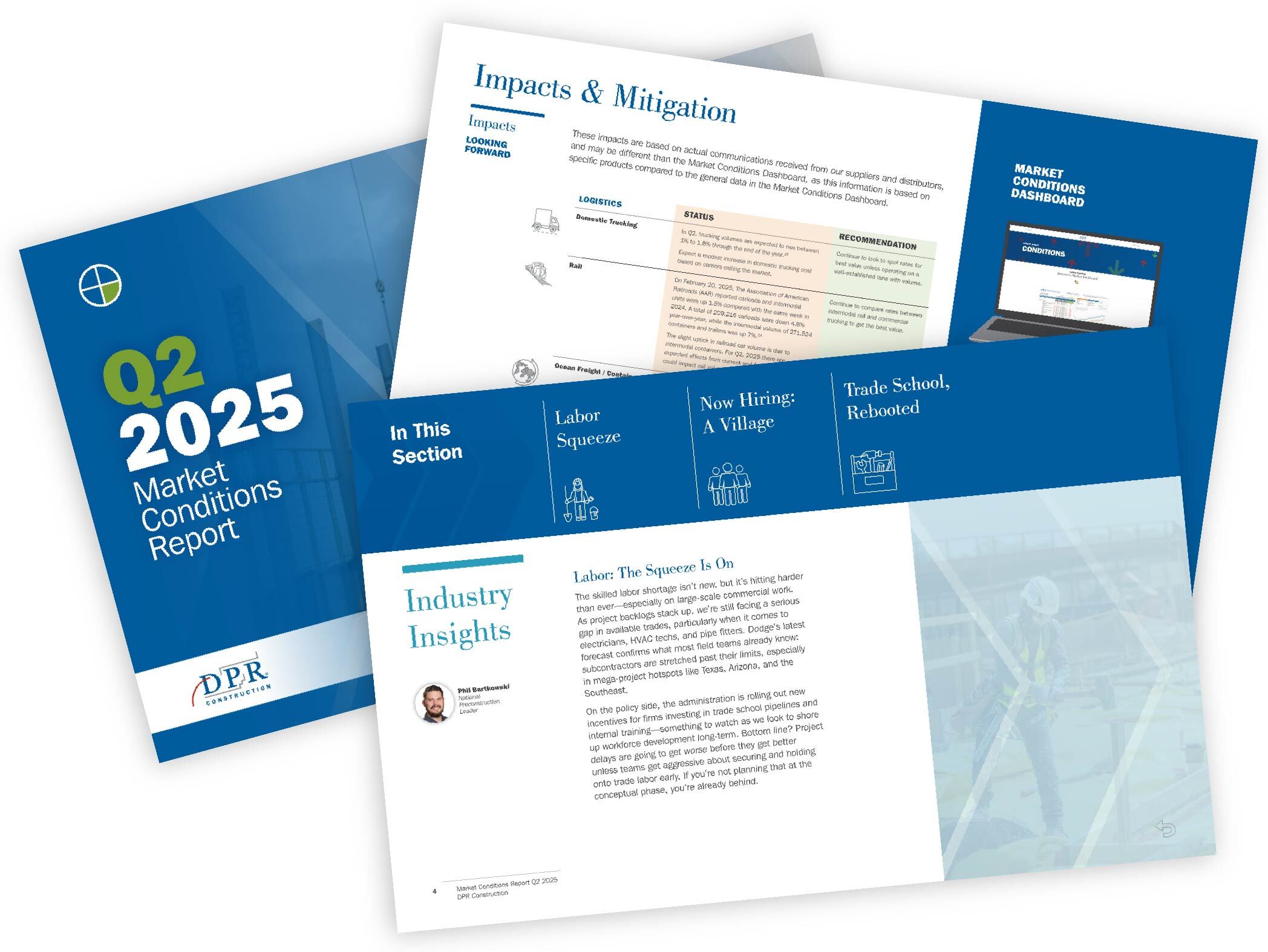


View
by Phil Bartkowski and Tim Jed 22 minute read
Our Q2 2025 Market Conditions report summarizes current market conditions, industry trends, and mitigation strategies to make more informed business decisions in the quickly changing construction landscape.
The skilled labor shortage isn’t new, but it’s hitting harder than ever—especially on large-scale commercial work. As project backlogs stack up, we’re still facing a serious gap in available trades, particularly when it comes to electricians, HVAC techs, and pipe fitters. Dodge’s latest forecast confirms what most field teams already know: subcontractors are stretched past their limits, especially in mega-project hotspots like Texas, Arizona, and the Southeast.
On the policy side, the administration is rolling out new incentives for firms investing in trade school pipelines and internal training—something to watch as we look to shore up workforce development long-term. Bottom line? Project delays are going to get worse before they get better unless teams get aggressive about securing and holding onto trade labor early. If you’re not planning that at the conceptual phase, you’re already behind.
The U.S. data center boom has barreled into remote and rural locations with plenty of cheaper land and power but not plenty of gigawatt-size electricians, pipe fitters or carpenters. In fact, mechanical, electrical and structural trades are in such short supply that industry executives say finding qualified construction folks is now nearly as tough as finding enough megawatts needed for rising demand. One report bluntly noted the need to “bring skilled labor to the rural areas” where these mega-projects are typically located. It turns out building hyperscale data centers in remote areas often means that you need an entire village’s worth of skilled tradespeople on speed dial—and the labor crunch is real.
Some roles that once took 8 weeks to fill are now taking 4+ months. When trying to staff a project the size of a small town, in a small town, no one is shocked, anymore, that the hiring signs might as well read, “Now Hiring: Entire Town.” However, there are mitigation strategies we can deploy to help keep you from reaching for the Tylenol.
These large, fast-paced projects further emphasize the need to align early with key trade partners. With the “we gotta go” drive in this market, there’s no time to waste on delays that can arise from misalignment with structural and mechanical trades on long-lead procurement. In doing so, we can maintain better control of the schedule and align early, prior to moving forward with a deal.
Through use of prefabrication, we can get exterior metal panels put in place at speeds far exceeding any typical tilt-panel construction. Further making the “need for speed” and hectic timeline less of a concern. Prebuilt electrical skids, mechanical pods, guard shacks—you name it, we are building it offsite to speed up the pace.
Although these hyperscale remote projects with challenging timelines remain uncommon, their popularity is growing due to the increasing demand for AI and cloud computing. To avoid the timeline headache: get in early with key trade partners, consider prefabrication and educate teams on data center demands and labor requirements to ensure a strong backlog workforce.
The construction industry has been talking about the labor shortage for years, but talk doesn’t pour concrete or wire a data center. The real question is, who’s stepping up to train the next generation of tradespeople? Fortunately, several organizations are moving and investing in tangible solutions.
These programs are more than just training initiatives; they’re strategic investments in the industry’s future. By providing accessible, practical education pathways, they’re helping to ensure that the construction workforce is robust, skilled, and ready to meet the demands of modern projects.
North America’s Building Trades Unions (NABTU) operates over 1,600 training centers across the U.S., offering registered apprenticeship programs that combine classroom instruction with on-the-job training. These programs not only equip workers with essential skills but also provide them with family-sustaining wages and benefits from day one.
Associated Builders and Contractors (ABC) offers flexible, competency-based training programs through its 67 chapters and 23,000+ members. Their approach includes just-in-time task training and work-based learning, leading to industry-recognized credentials that prepare individuals for various construction roles.
National Center for Construction Education & Research (NCCER) provides a modular, customizable curriculum covering over 40 construction crafts and disciplines. Their programs are designed to meet the needs of diverse apprenticeship programs, ensuring that training is tailored to specific industry requirements.
YouthBuild USA focuses on empowering young people aged 16 to 24 by offering education, job training, and leadership development. Participants spend alternate weeks on construction sites and in classrooms, gaining practical experience while working towards their high school diploma or GED.Furthermore, DPR is investing in a program targeted at recent graduates to provide strategic training within a new hire’s first 18 months. Focusing on field-specific training and on-site experience, we will have better builders long-term. Understanding the details is important. Foregoing that depth of training means that a new project engineer might only know how to handle RFIs and submittals without ever really understanding the difference between #6 and #18 rebar, or if we should put the rubber base on before or after the painter has done their work. Building better builders requires dedicated energy to provide this level of training and experience in the field.
The construction industry is thriving in the markets we serve, and it’s not just growth, it’s transformation. We’re witnessing a shift into new geographies, emerging technologies, and evolving expectations around people, cost, and time.
To stay ahead, we have to think differently. That means embracing innovation, adapting to dynamic demands, and reimagining how we build—faster, smarter, and more sustainably. Whether it’s navigating complex supply chains, leveraging data-driven insights, or building stronger partnerships, we’re not just keeping up—we’re leading the way.
We’ve all heard the ongoing news regarding tariffs, including those on McDonald and Heard Islands, whose main population is…penguins. So while they have no actual exports,1 if these little inhabitants decide to export their tuxes to the U.S., it will be at a higher cost, as will any other items being exported from other countries to the U.S. Tariffs are not yet reflected in our economic data, with the inflation rate for April at 2.3%, which was the lowest since February 2021.2
Unemployment ticked up slightly to 4.2% in March3 and remained at 4.2% in April, with construction hiring slowing in February, even as the construction unemployment rate ticked down from February to March.4 Construction input prices increased by 0.6% in March, marking the third month of increases, led by steel, copper, structural metal products, lumber, adhesives and sealants, and electrical gear.5 Architectural billings have been soft but ticked up slightly in February.6 And despite Microsoft pausing some of its data centers,7 Nvidia is increasing its investment in U.S. chip manufacturing.8
The stock market has been highly volatile in recent weeks, driven by the news of new tariffs and reports from the Fed saying that tariffs are expected to increase inflation and slow economic growth.9 Contractors are cautious, with fewer than 26% expecting profits to rise over the next six months, and 40% expecting a decline, even though the backlog improved to 8.5 months, up 0.2 months from February.10
Some indicators are telling us things are going well, while others tell a different story. The most common questions we’re being asked to address on tariffs are: “How much will this cost?” and “Should we just buy everything now to lock it in?” The short answer is that it depends on the project, trade, manufacturer, and their supply chain. What is clear is that there is a lot of uncertainty regarding this topic, where we are, and where we are headed.
In a few short months, we’ve been deluged with news about new tariffs, tariff rates, paused tariffs, and exceptions. Our supply chains are global, nuanced, and complex, and the details matter, making it difficult to develop a clear strategy. This quarter, we’ll take a deep dive into this topic, look at what’s happened, and explore what we can do about it.
Unlike standard duties, which are indirect taxes to help moderate global trade, tariffs are direct targeted taxes and can shift quickly based on geopolitical and economic developments. They are intended to raise the price of imported products to make them less cost-advantaged, thereby bringing more demand and manufacturing back to U.S. producers.
Indirect taxes used to help moderate global trade
Targeted direct taxes on imports that vary based on country
The current global tariff situation is evolving rapidly and companies are reacting. We’ve been tracking, logging, and analyzing every notice we’ve received from suppliers. Since January 20th we’ve already received almost 4,300 impacts with some related to cost and others to longer lead times.
Will the tariffs work? Time will tell. The steel and aluminum industries added more than 80,000 jobs between 2017 and 2019 that resulted from the tariffs of 2017 and 2018, but the broader impact on U.S. manufacturing has been limited. Bringing manufacturing back to the U.S. is complicated, expensive,11 slow, and difficult due to existing labor constraints.12
Even if manufacturing is brought back to the U.S., many raw materials and products used to manufacture materials will likely remain imported. With the complexity and number of goods used to produce any one item, it has been difficult to predict the true impact. This is due to three main issues:

The updates to the HTS (the Harmonized Tariff Schedules) are managed by the U.S. International Trade Commission, and they have been slow in coming, due to the sheer volume of changes and amount of information that needs to be updated throughout the code, which is thousands of pages long.

While the executive orders are relatively straightforward, the detailed application of the tariffs need to be stitched into the HTS at a very detailed level. With the many footnotes, cross-references, exceptions, and exclusions, proper application is complicated.

Different manufacturers have different supply chains for products. In a recent analysis of a global maker of transformers and power converters, we learned that their supply chain for these products uses 1,257 unique suppliers from 156 countries. These chains shift constantly, as suppliers earlier in the chain tend to buy things more tactically. This adds time and complexity to the suppliers figuring out their end costs.
The new tariffs in 2025 include semiconductors, the removal of special country exceptions and quotas on steel and aluminum (and an increase on aluminum from 10% to 25%), tariffs on China of 30%, tariffs on Canada and Mexico of 25% for items outside the USMCA (United States-Mexico-Canada Agreement), with a 10% tariff on petroleum from Canada (which is 24% of the U.S. refinement capacity), and a global tariff of 10% on all other countries (this replaced the reciprocal tariffs that were paused for 90 days and are significantly higher for many countries).
On May 28th the U.S. Court of International Trade blocked the tariffs imposed on April 2nd,13 and an appeal made by the White House was upheld a day later, signaling a continuation of the current tariffs for now.14 We’re also seeing reports that the U.S. is assessing additional port fees to ocean carriers for vessels built in China or tied to Chinese entities, from $18 per ton or $120 per container,15 which would add up to $2.9 million to the largest Chinese ships.

CHART: Tariffs - Then vs. Now
* Exceptions for Canada, Mexico, Australia; allowed quotas for Argentina, Brazil, South Korea, the EU, Japan, and the United Kingdom
** Exceptions for items covered by the U.S. Mexico Canada Agreement (USMCA) which have no tariffs.
*** 24% of U.S. petroleum comes from Canada.
These tariffs will ripple across product costs, depending on where the material comes from, and the level of transformation of the product (e.g. raw steel, versus coil, versus studs, versus wall systems). Steel and aluminum were already subject to longstanding tariffs, but as much of the supply chain had already shifted to providers who were previously excluded from tariffs, we would expect these costs to be impacted. Electrical equipment and transformers contain many imported components, and Mexico is a major importer. The chart below shows the top ten items imported to the U.S. from our largest trading partners, China, Mexico, and Canada, and what we think will affect construction.
Some products, like drywall and concrete, are domestically produced. West Coast drywall, however, uses gypsum rock from Mexico. If the USMCA stays in place, drywall should not be impacted due to tariffs, as gypsum is protected under this agreement. However, if the USMCA is set aside, a 25% tariff on Mexican rock should be around a 3% increase to the installed price. But that’s not the whole story. The bigger concern for drywall is the additive Siloxane, which is mostly produced in China. This is a concern because the tariffs have started trade wars, the most concerning happening between China and the U.S.

CHART: Top U.S. Imports + Potential Project Impacts
The top ten items imported to the U.S. from our largest trading partners, China, Mexico, and Canada, and what we think will affect construction.
In recent news, along with high tariffs countering the U.S. tariffs, China announced it will be limiting exports of rare earth elements to the U.S.16 These are 17 materials that are used in electrical and electronic components, lasers, glass, magnetic materials, and industrial processes, with the vast majority are mined and refined in China. This could be a problem for domestic manufacturers of construction materials where rare earth materials are needed by manufacturers in the U.S. to make these products:

CHART: Refined Production of Rare Earth Materials (2023)
Source: International Energy Agency
But we’re seeing some encouraging news, too, including positive movement on negotiations with other countries, like the announcement in early May lower tariffs on the UK, including lowering steel to 0%.17 There was also a deal signed with Ukraine that allows for U.S. access to Ukraine’s rare earth elements. This is particularly relevant, as China, the main source of rare earths for the world, has placed export controls on seven of these materials, and the deal with Ukraine helps to provide a path to securing access to some of those materials for the U.S.18
In general, the less transformation that happens to a product prior to its import, the lower the impact should be. For example, if iron ore is imported to make steel in a U.S. mill, that should have a lower overall impact than if the steel is imported as a fabricated detailed structural steel beam. The question is whether the total cost of one choice is better than the other, which requires analysis. Blanket assumptions, like “there’s a 25% tariff on steel so just add 25% to the installed price” should be reviewed and assessed and are likely not directionally accurate. But tariffs on imports can also affect the pricing of items produced in the U.S. for opportunistic reasons, as some U.S. makers may increase their price beyond their cost increase.
In cases where the final manufacture and assembly of products happens in the U.S., the cost impact should be a percent of a percent of a percent of the subcontracted value. The formula looks like this:
A * B * C * D = E | where:
A = Subcontract value of the trade |
The rapidly shifting policy has made it difficult to know when to buy versus when to wait. For example, reciprocal tariffs that were in place at midnight one evening were paused by the next afternoon and then replaced with a global tariff of 10%—had you committed to buy something the day before the pause, it is likely the suppliers would have included the tariffs in their price, increasing it significantly.
So simply buying everything now is unlikely to be the best strategy. This does, however, emphasize the importance of digging into the particulars on each item, tracking them at a detailed level in real-time, and providing that filtered, pertinent information to our front-line teams. Our teams can then apply the information on a trade-by-trade, and manufacturer-by-manufacturer basis, prioritizing higher spend, higher risk items first to get the best project result.
“Excellence, then, is not an act but a habit.” - Aristotle
At DPR we’ve focused in recent years on building unique and innovative tools to provide data and actionable analytics to our frontline teams. They understand the project needs best and utilize these analytics to work toward the best option for their projects, with our supply chain team and our DPR family of companies supporting our teams through ability to buy materials direct, store them, and leverage the deep manufacturer and supplier relationships we’ve cultivated.
Understanding the details of the tariffs, how to apply them, and how to approach conversations with our partners to gain intelligence and appropriate pricing is key. A targeted approach is best, using allowances rather than locking in the entire budget now to address potential cost impacts. This prevents locking in pricing at unreasonably high levels that may ease over time—which has already occurred on several occasions since January.
Strategies that can be leveraged to abate tariffs include considering domestic products or items which are already in stock, purchasing early and using our flexible storage options, pre-payment to manufacturers and storing goods, as well as many other options. Open conversations between customers, design teams, and trade partners are critical. Working collaboratively, we learn and share what we know about tariffs and create an environment where thoughtful, data-driven answers and transparency are rewarded, which leads to the best project result.
It is difficult to know what the outcome will be, but there are positive signs. In a webinar hosted by the Brookings Institute, trade experts from Japan, the EU, Mexico, and the U.S. spoke about the challenges and dangers of the current U.S. position, but they also had a reconciliatory tone, and countries seem to be coming together to work through compromises, suggesting that in the end, there could be improvements in the trade deals with the U.S. juxtaposing those with the potential risks around world relations and other unintended consequences.19 In other recent encouraging news, as we’ve seen an easing to the tariffs for consumer electronics20 and news of relaxing tariffs on automotive21 and Chinese goods.22
DPR has substantial supply chain expertise and experience. We understand what information is needed, where to get it, the nuances, and how to apply it. We’ve built tools and programs to help overcome these issues, like direct material procurement and temporary storage solutions. We’ve modeled different scenarios to proactively understand and build resiliency into our supply chain, and we understand the details which give us insights that others don’t have, to get in front of issues and solve them proactively.
DPR’s combination of the right people, programs, tools, and relationships enables us to do a better job mitigating increases and overcoming lead time challenges as we navigate the current climate of tariffs.
These impacts are based on actual communications received from our suppliers and distributors, and may be different than the Market Conditions Dashboard, as this information is based on specific products compared to the general data in the Market Conditions Dashboard.
| Impact | Cause | Action |
| Domestic Trucking | In Q2, trucking volumes are expected to rise between 1% to 1.6% through the end of the year.23 Expect a modest increase in domestic trucking cost based on carriers exiting the market. | Continue to look to spot rates for best value unless operating on a well-established lane with volume. |
| Domestic Rail | On February 20, 2025, The Association of American Railroads (AAR) reported carloads and intermodal units were up 1.5% compared with the same week in 2024. A total of 209,216 carloads were down 4.8% year-over-year, while the intermodal volume of 271,524 containers and trailers was up 7%.24 The slight uptick in railroad car volume is due to intermodal containers. For Q2, 2025 there are expected effects from current and future tariffs that could impact rail volume and costs. | Continue to compare rates between intermodal rail and commercial trucking to get the best value. |
| Ocean Freight/Containers |
The U.S. Trade Representative announced a proposed action that would target China’s growing influence in the shipbuilding industry by imposing fees ranging from $500k to $1.5 million per U.S. port call by any Chinese carrier, Chinese vessel, or other carrier that has Chinese vessels as part of their global fleet.25 The U.S. Trade Representative released their Section 301 investigation, “Report on China’s Targeting of the Maritime, Logistics and Shipbuilding Sectors for Dominance.” This report provides trade imbalance information and justification for additional tariff and costs for using Chinese Shipping and Shipbuilding capabilities. 26 |
Be prepared to pay for increased fees on Chinese-owned vessels offloading cargo at U.S. Ports. |
| Fiberglass Reinforced PVC Piping 60-week lead time |
Pre-buying to avoid tariffs. | Investigate project needs and place orders as soon as possible. |
| Switchboards 52-week lead time |
Continued long lead times. |
Investigate project needs and place orders as soon as possible |
| Medium Voltage Wire and Cable 40 to 60-week lead time |
Continued long lead times. | Investigate project needs and place orders as soon as possible |
We’ve received almost 4,300 impacts from our manufacturers and suppliers, who have communicated significant cost implications for their products. We’ve compiled, analyzed, and summarized what we are hearing below. These are not negotiated prices, but rather an aggregation of the notices we’ve received. A trade-by-trade strategic approach is needed to evaluate each project to assess to ensure the best outcome for each project.

CHART: Tariff Related Impacts
A summary of the trade impacts DPR Construction has received from our manufacturers and suppliers since January.
Logistics Lead
In any city, commercial construction balances zoning laws, community disruptions, logistics and storage hurdles, environmental and social needs with schedule and cost. For the city and our teams, ensuring and improving access to utilities like gas, electricity and water are a shared reality, but with potentially conflicting priorities. DPR is adept at helping our owners navigate these intricacies.
DPR is building a project in our mountain states region for a customer who has additional projects under construction, all overseen by different general contractors. On one of these other projects, a municipal requirement to lower a waterline required installation of a long lead time 36” butterfly valve. Even though DPR is not overseeing this project, the customer reached out to DPR for help. We leveraged our deep supplier relationships and went to work to source the product. Looking across our national supply chain, we located the required valve in another state. The outcome? Katy Corrigan, DPR’s Get Work Leader for the Mountain States Leader shared the owner’s sentiments: “YOU GUYS ROCK!!!” adding, “I am going to share all of the backstory and how you guys sourced one within a day when we were told 10 months.”
On another project, the DPR pursuit team was challenged by the 32-week lead time for an UPS (uninterruptible power supply). They engaged our supply chain team with the goal to save time through direct purchase. The procurement team reached out to our supplier partners to find options, where they learned that the specified product would be obsolete after January 2026. Not only was the lead time reduced to 10 weeks, but our subject matter experts uncovered and addressed an obsolescence issue by using a different product, which prevented further downstream schedule delays.
Having in-house chain capabilities like sourcing, direct procurement, and warehousing, combined with deep subject matter expertise, is a true differentiator for DPR customers. It helps us capture benefits including pricing and lead time improvements, additional purchase and fulfillment options, and improved results. Katy Corrigan characterized the butterfly valve anecdote as “one of those little nuggets that really help us continue to show that we are the right partner. It shined a light on our procurement team just being such a differentiator and a resource when it came to helping people out in a pinch—that talent is a value they bring.”

Fear of the unknown exists but the life sciences industry is poised to make history.

Finding solid footing in a shifting landscape

Cautious optimism mixed with robust growth opportunities

Chaos, disruption, and uncertainty

Tariffs, cost pressure, and policy fallout

Check out our current conditions interactive dashboard.
Information in this report is compiled from third-party reporting that is available to the public. It is not owned by DPR Construction.
As of May 30, 2025, the content in this section reflects the most current market data available. Given the dynamic nature of the global market, changes occur daily. For the latest updates and insights, please consult your local DPR contact.
United States Census Bureau
United States Department of Labor
United States Energy Information Administration
United States Chamber of Commerce
United States Bureau of Labor Statistics
Engineering News Record
American Institute of Architects
Cumming Corporation
1 Trump's tariffs target Heard Island and McDonald Islands, Australian territory inhabited by penguins - CBS News
2 Current US Inflation Rates: 2000-2025
3 Civilian unemployment rate
4 Industries at a Glance: Construction: NAICS 23 : U.S. Bureau of Labor Statistics
5 Construction materials costs rise for third month on tariff pressures | Construction Dive
6 AIA | Architecture Billings Index
7 Microsoft Hits Pause Button on $1B in Data Centers in Ohio | Engineering News-Record
8 Nvidia to spend $500B to manufacture AI chips in US | Construction Dive
9 Fed Chair Powell sounds alarm on tariffs, sending stocks lower
10 Tariff fallout hits contractor confidence | Construction Dive
11 Reshoring Supply Chains: Challenges & Costs Revealed in CNBC Survey
12 Manufacturers Revamp Supply Chains Amid Shifting Trade Policies
13 Trade Court Blocks President Trump Tariffs ruling they exceed legal authority
14 Federal Appeals Court halts decision blocking Trumps tariffs
15 New U.S. Fees on China-Linked Ships to Boost Domestic Shipbuilding
16 Why China curbing rare earth exports is a huge blow to the US
17 Recap: Trump announces US-UK trade deal with focus on steel, autos and beef
18 Ukraine and the US have finally signed a minerals deal. What does it include?
19 Global responses to an American reset of international trade | Brookings
20 Trump Adds Tariff Exemptions for Smartphones, Computers and Other Electronics - The New York Times
21 Auto Stocks See Brief Spike In After-Hours Trading Wednesday As Trump Plans To Ease Tariffs On Automakers Ford, GM, Stellantis Stocks Briefly Spike In After-Hours Trading Wednesday - Benzinga
22 Trump Signals Easing Of China Tariffs, Says 145% Rate “Won’t Be Anywhere Near That High”
23 https://coyote.com/resources/r...
24 https://www.freightwaves.com/n...
25 New U.S. Fees on China-Linked Ships to Boost Domestic Shipbuilding
26 USTRReportChinaTargetingMaritime.pdf
Photos: Danny Sandler

National Preconstruction Leader

Posted on June 3, 2025
Last Updated March 13, 2026
File Download


